Monday, October 26, 2009

Gettysburg Semester 2009 - Gettysburg, Day One

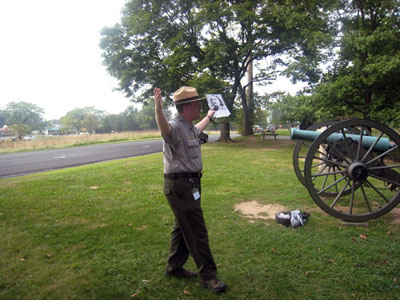
Last Friday, we slept in and stayed home for a tour of the First Day at Gettysburg! Although we’ve all been to the battlefield before – certainly since being here, including a few walks with our own Zack Fry – I was excited to begin the Gettysburg Semester’s three-week exploration of the battle. We met our guide, John Archer, at East Cemetery Hill, which he and Dr. Guelzo explained was the reason for fighting at Gettysburg. We were able to understand this looking around, for the plateau commands a view of the entire surrounding area.

Making our way to the location of the alleged location of the “first shot” fired during the battle, John Archer explained the reasons for Lee’s invasion and impressed upon us that the fighting at Gettysburg was not planned. We then made our way to McPherson’s Ridge, where Mr. Archer described Buford’s holding action and Reynolds’ arrival. We followed a path through the woods to Willoughby Run, where we discussed the Iron Brigade’s flanking maneuvers against Archer’s men. (Not to mention enjoyed the lovely fall colors while we were surrounded by trees and falling leaves!)

We then continued to the unfinished railroad cut, where Mr. Archer explained the fighting of the 6th Wisconsin, the 14th Brooklyn, and the 95th New York there. (My darling roommate even sported a 14th Brooklyn kepi!) We then went to Oak Ridge and Oak Hill, where we discussed the bloody action between Iverson’s and Robinson’s men – and Jacob Dinkelaker made some hilarious tasteless jokes about Sally Ann, the 11th Pennsylvania’s mascot dog. We also talked about issues of battlefield preservation and tourism at Gettysburg, including Gettysburg College’s destruction of the other railroad cut.

After eating at the Appleford, we made our way to Barlow’s Knoll, and Mr. Archer explained the composition of the Eleventh Corps and their fighting against and retreat from Gordon on July 1. Afterward, we made our way back to the woods, discussing the First Corps retreat and walking the 24th Michigan’s fighting retreat from the 26th South Carolina. We concluded the day on Seminary Ridge with an explanation of the Union retreat through town, their last stand at Seminary Ridge, and their ultimate withdrawal to Cemetery Hill. Just as Mr. Archer finished his discussion about the criticism of Ewell for not taking Cemetery Hill, it began to rain and we headed back into the bus. This week, we’re staying here again for Gettysburg, Day Two!

Monday, October 19, 2009

Gettysburg Semester 2009 - Fredericksburg and Chancellorsville

On Friday, October 16, we left Gettysburg for Fredericksburg and Chancellorsville, bundled up against the cold and rain. Upon arrival, we soon discovered that these battlefields are a testament to those throughout the country that suffer from encroaching development and lack of preservation. Nevertheless, our guide, Greg Mertz, was able to make his tour incredibly meaningful. He provided us with incredibly interesting documents about each of our regiments, which we read aloud at intervals over the course of the day. I think we all greatly appreciated Mr. Mertz’s efforts for us in this respect – for my part, the letters and diaries he gave me really drove home the soldier’s experience at Fredericksburg and Chancellorsville.

In the morning, we toured Fredericksburg. Our first stop was along the Rappahannock, where we discussed the Federal troops’ crossing of the river and the heated action in the town. We then headed toward Marye’s Heights, where despite development, we were able to truly understand the horrifying futility of the Union attacks there. Discussing the casualties many of our regiments suffered was chilling. We finished the tour of Fredericksburg with a visit to Prospect Hill and went over Franklin’s attack and the Confederate position there.

After lunch and the obligatory bookstore visit, we moved on to Chancellorsville. After Mr. Mertz detailed Lee’s plans for the upcoming battle, we went to the area of Howard’s XI Corps position. Here, Jackson launched an attack against the unprepared corps, which was forced into a hasty retreat. We then made our way to the Chancellorsville Visitor’s Center and the approximate spot where Jackson was mortally wounded in the battle. Thereafter, we rode toward Hazel Grove and walked toward Fairview, surveying Sickles’ position there and the consequences of the Union abandonment of it. We concluded our tour with a visit to the Salem Church and a brief talk about the action there – and Mr. Mertz pointed out the position of my regiment, the 2nd Rhode Island, as “near the Taco Bell.” (Certainly unfortunate evidence of a lack of battlefield preservation.)

After a long, rainy drive back home, most of us finished the day with dinner with Dr. Guelzo at Tommy’s and continued to discuss the Civil War over pizza – a lovely end to the day, if I do say so myself! Next week, we’re staying in Gettysburg to discuss the first day. (And let’s all hope for better weather, shall we?)

Monday, October 12, 2009

Gettysburg Semester 2009 - Antietam

During the second week of October, we departed early and made our way to Antietam. We were greeted by unseasonably warm weather – a welcome change from our previous trips! This was the first battlefield that we’d visited that I’d seen prior to the Gettysburg Semester, so I was excited to see and experience it again.

We were very fortunate to have Dennis Frye as our guide for the second time, particularly because so much of his personal and family history has ties to the Battle of Antietam. After becoming acquainted with the topography of the area, we went to the Pry House, McClellan’s headquarters during the battle. Here, Mr. Frye challenged us to consider the battle in terms of contemporary practicality rather than focus heavily on reports – which, especially in McClellan’s case, are not always trustworthy.

We then made our way to the Cornfield and the West Woods, where Dennis Frye took us to an area where, as he described, the terrain truly changed the course of American history. We learned that the action at the West Woods was the (extremely bloody) turning point in the battle, as it put McClellan on the defensive for the remainder of the day.

After leaving the West Woods, we headed to the Sunken Road (or “Bloody Lane”), where Mr. Frye argued that contrary to popular belief, French’s division did not get lost – rather, their arrival there was entirely intentional given the realities of terrain and position. Before leaving, we participated in a Gettysburg Semester tradition: reenacting “the bloat” from Alexander Gardner’s famous photographs of the Bloody Lane after the battle. (Insensitive, yes, but tradition IS tradition!) We then got ourselves up and climbed the stairs to the top of the observation tower, where Mr. Frye told us a moving story about the discovery of several soldiers from the Irish Brigade who were partially buried on the battlefield.

Our final stop was Burnside’s Bridge, where Mr. Frye maintained that Burnside’s actions were brilliant, rather than foolish, at Antietam. After a group picture (sans Dr. Guelzo) on the bridge, we went to Nutter’s ice cream – the perfect complement to a long, hot, and incredibly enjoyable day on the battlefield! As we drove back to the Visitor’s Center, Dennis Frye explained the end of the battle and Lee’s withdrawal on the 18th of September. Overall, a great trip – on to Fredericksburg and Chancellorsville next week!

Monday, September 28, 2009

Gettysburg Semester 2009 - Manassas

At the end of our third week of classes, we made our way to Manassas. Dr. Guelzo couldn’t join us, but we managed to arrive in one piece somehow. And, despite early signs of inclement weather, we were fortunate enough to avoid rain!

After joining our leader and guide Jim Burgess, we toured a variety of sites related to the First and Second Battles of Bull Run (Manassas), including Blackburn’s Ford, Signal Hill, the so-called “Liberia House” used as headquarters by Beauregard, and the Ben Lomond House (where were learned about everything from a French-hating presidential pet to forensic blood analysis technique).

After lunch, Jim Burgess took us through the phases of the 1st Battle of Bull Run, beginning with the Stone Bridge. We then walked up to the area demarcated as Farm Ford, and Jim Burgess explained that its real location is likely a couple hundred yards farther up. (I thought his presentation of this was a really interesting example of historical detective work. Really fun!) After looping around the trail back to the Stone Bridge, we hopped on the bus to Sudley Church, which Hunter’s division passed on the way to its attempted flank attack on the left of McDowell’s line. We then drove to Matthews Hill, where Burnside’s and Porter’s brigades engaged with the outnumbered Col. Evans. (And where the 2nd Rhode Island fought alone for the better part of a half hour and was able to push back the Confederates!) After that, we stopped (and posed) at the Stone House, used as a field hospital during the battle.

Our final stop was Henry House Hill, where we were all greatly distracted by the overwhelmingly disproportionate monument to Stonewall Jackson. (The muscles of his wildly inaccurate horse seem to blend with those of his wildly inaccurate legs and torso. Something is clearly very strange here.) In any case, we heard from Jim Burgess about the action and ultimate Confederate victory at Henry House Hill – and the physical and psychological aftermath of the First Battle of Bull Run for both sides. As the clouds began to break, we departed Manassas in high spirits – and began to look forward to Antietam in two weeks!

Monday, September 21, 2009

Gettysburg Semester 2009 - Special Collections

This past week, in lieu of another battlefield trip, we were introduced to the Gettysburg College Special Collections. Director Karen Drickamer kindly gave us a detailed description of the procedure necessary to do research in the Special Collections and presented to us a sampling of the items available therein. Among reference materials for both the College and the battle, there were many very interesting pieces, including two Civil War diaries and a book in which a solder had written his name while in the hospital at Pennsylvania Hall.

Although brief, the visit offered a glimpse at the wealth of research materials available to us as Gettysburg College students – and I’m extremely excited to work in the Special Collections over the course of the semester!

--------

Visit the Gettysburg College Special Collections website to see the myriad resources available to researchers. The GettDigital collection offers many resources to the public online as well.

Monday, September 14, 2009

Gettysburg Semester 2009 - Harpers Ferry

Last Friday, September 11, we woke up early and made our way toward Harpers Ferry, West Virginia. It was a rather gloomy, rainy day, but that didn’t dampen our excitement! (Although my roommate and I both forgot coats. Lesson learned!)

After meeting Dennis Frye at the Vistor’s Center, we went to the Lower Town area, most famous for John Brown’s “raid” in October of 1859. Before we went through the town itself, however, Dennis Frye introduced us to the reasons for which Harpers Ferry developed as it did. Of particular importance is the Shenandoah River, which made the town an excellent location for the establishment of mills. We saw one in particular that served as a hospital during the Civil War.

We then walked through the town, most of which was destroyed due to the Civil War and continual flooding. Dennis Frye walked us through the layout of Harpers Ferry as it would have looked when John Brown arrived there. Most interesting was his emphasis on John Brown’s original intentions for the “launch” of his war against slavery. We moved through the areas of particular importance to John Brown, such as the armory and the arsenal, and ended our walk at the old firehouse. Dennis Frye’s animated demonstration of the last moments before John Brown was apprehended there were both entertaining and powerful.

After a much needed lunch-break huddled in the van, we set out for Bolivar Heights to discuss the Battle at Harpers Ferry in September of 1862 during the Maryland Campaign. Dennis Frye thoroughly covered the issues of topography and terrain at Harpers Ferry, explaining the strategic importance of Maryland Heights, Loudon Heights, and Bolivar Heights. He then took us to the Confederate position at Schoolhouse Ridge, where we simulated marching in line – much more difficult than I had imagined! Finally, we went to the area where A.P. Hill’s flanking maneuver forced the Union to surrender and got a gorgeous view of the Potomac River. Exhausted, wet, but completely content, we made our way back to the bus. I, for one, spent the ride back home humming “Take Me Home Country Roads” and looking forward to our trip to Manassas!


Wednesday, September 9, 2009

Welcome our 2009 Blogger: Annie Powers

The school year has once again begun, and it is time now for our Gettysburg Semester students to begin their sojourns around Pennsylvania, Maryland, Virginia and more. The Civil War Era Studies Department is pleased to introduce Annie Powers, our 2009 Blogger. Annie hales from the University of California at Berkeley, and is one of two students we have this year who've made the trek to Gettysburg from the "Golden State." Annie will be writing about her weekly travels with Dr. Guelzo and her fellow students. Look for her first update from the field (Harpers Ferry, WV) next Monday.

Below is Annie's first submission, a recap of her first experiences at Gettysburg College and with the Gettysburg Semester during the Orientation Week. Without further ado, here's the news from our students:

----------

Orientation Week

Gettysburg. A small, historic-minded town with a population of about 7,500 and a college with 2,600 students. After living in the San Francisco Bay Area and attending the University of California at Berkeley, a state university with nearly 26,000 undergraduates, I didn’t quite know what to expect. But when I arrived at the Appleford, our residence for the semester, and the idea of studying the Civil War in Gettysburg began to sink in, I realized (as trite as this will sound) that this place would quickly become home.

When I arrived at the Appleford, I all but collapsed onto my bed after getting almost no sleep on a red-eye flight from California into D.C. Thankfully, Dr. Guelzo, Cathy Bain, and a bunch of other students helped me haul my heavy luggage upstairs and got me acquainted with the house. Admittedly, those first few hours were blurred by my exhaustion, but I was delighted to finally be in Gettysburg.

After dealing with logistical issues and bonding with my darling roommate Sam, Dr. Guelzo treated us to dinner at the Dobbin House. It was super delicious and, as Jacob Dinkelaker described it, “olde-timey.” When we returned to the Appleford, most people played a game of Monopoly, but personally, I was fast asleep by 10:00 pm.

The next day, we were given a tour of Pickett’s Charge by Dan Welch, a Gettysburg Semester student from 2005. I was both impressed by his walk and excited about the opportunities that studying here at Gettysburg College clearly offers us.

Later that evening, we participated in the First Year Walk, a tradition in which first-years follow the path that Pennsylvania College students and faculty took in 1863 to see the dedication of the National Cemetery. All of us Gettysburg Semester students were at the front of the crowd, unmistakable in our blindingly orange T-Shirts. (We were even featured on the College website!) Upon arrival, we listened to the Gettysburg Address read by former NAACP president Bruce Gordon. There is something so powerfully eloquent about the Gettysburg Address that captivates me no matter how many times I have read it or heard it spoken. Dr. Guelzo then treated us to Kilwin’s Ice Cream, which had the best waffle cones I have ever tasted and will probably be the place where the majority of my money is spent this semester.

Over the weekend, we all tried to visit the battlefield in some way, going in groups or exploring the ground alone. This week, classes and internships are beginning, and I am extremely excited to see and experience absolutely everything uniquely Gettysburg over the next three months!